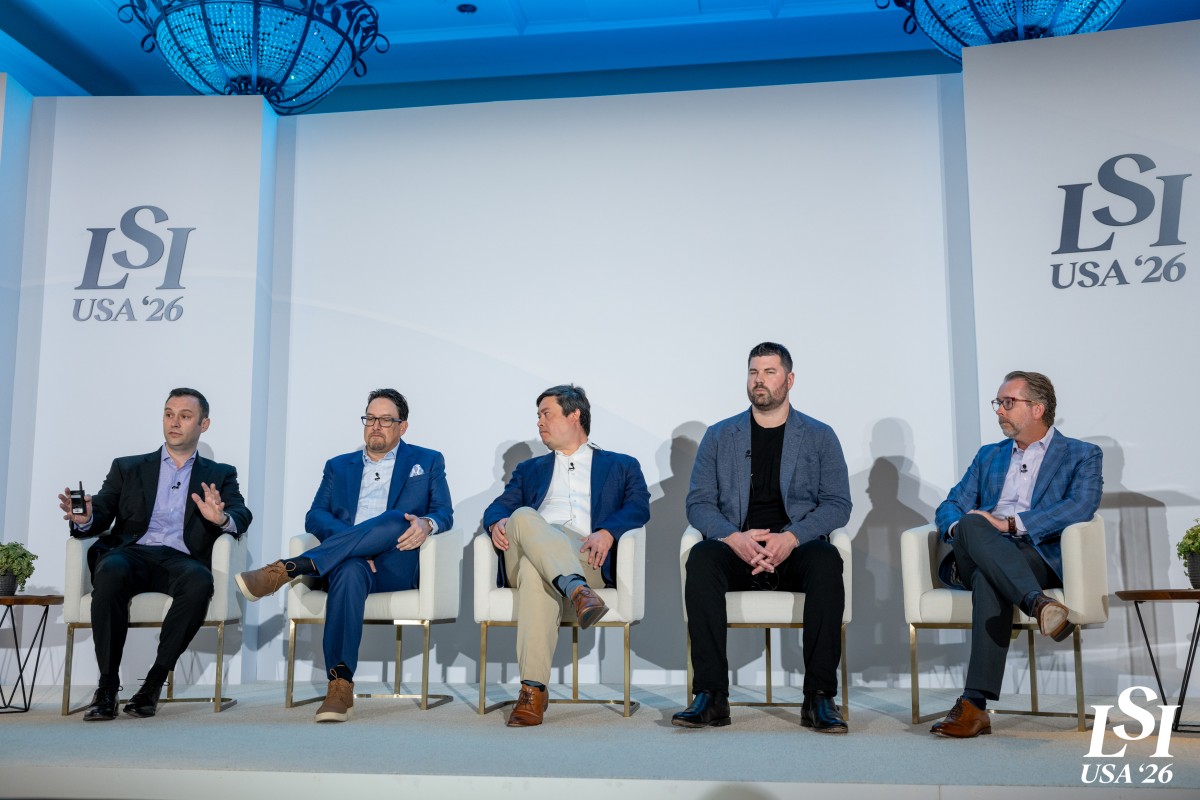
At LSI USA ’26, the panel “Medtech M&A: An Optimist’s Perspective on the Future of Medtech” brought together leaders from EY-Parthenon, Medtronic, Evercore, Vensana Capital, and Edwards Lifesciences to discuss the state of dealmaking, capital deployment, and strategic growth across the industry. The conversation made one point clear: medtech M&A 2026 is not simply about whether deal activity returns. It is about how capital gets deployed, which assets attract strategic attention, and what companies need to prove before they can become must-have acquisition targets.
Moderated by John Heinbigner, Partner at EY-Parthenon, the panel featured Chris Eso, VP, Global Head of Corporate and Business Development, M&A and Ventures at Medtronic; Bennett Blau, Senior Managing Director at Evercore; Greg Banker, Partner at Vensana Capital; and Chad Rice, Senior Vice President of Corporate Development at Edwards Lifesciences.
A Market Defined by Strong Fundamentals and Selective Capital
The panel opened with a look at a market that appears healthy in some ways and challenged in others. Heinbigner noted that the overall medtech market grew about 6% in 2025. Underlying fundamentals, including utilization volumes and capital spending, remain strong.
But public market sentiment has not fully reflected that strength. Heinbigner pointed to a disconnect between industry fundamentals and equity market performance, noting that medtech has been trading at a discount despite historically trading at a premium.
Blau described the current environment as “a very schizophrenic market environment,” pointing to a broader market where the S&P 500 has held up better than many would have expected given macro and geopolitical turmoil, while medtech has remained challenged.
“If you look at a longer period of time, we live in an environment where over the last three years you have the S&P 500 up roughly 70%,” Blau said. “If you then zero in on healthcare, it’s anywhere between 20 to 25%, and then you zero in on medtech, and it’s down anywhere between 5 to 10%.”
That backdrop has also shaped the IPO environment. Blau described the market as “incredibly selective,” especially for medtech companies looking to access the public markets.
Why Growth Is Driving Medtech M&A 2026
For strategic acquirers, growth remains the central theme. Blau emphasized that the number of scaled, high-growth public medtech assets has narrowed considerably in recent years, creating scarcity for large strategic buyers seeking assets that can move the needle.
“We sit here today where when you look at all of the public assets that exist in medtech out there, they’re not enough really to collectively move the top line profile of some of the acquirers,” Blau said.
That scarcity matters because growth is increasingly tied to valuation. According to Blau, every one percentage point of revenue growth in the pre-COVID period corresponded to roughly one to one and a half turns of EBITDA valuation. Today, he said, that same point of growth may be worth closer to two and a half to three turns of EBITDA.
In that environment, he sees two paths for strategics: acquire growth or divest slower-growth businesses to improve the overall profile of the company.
“I am quite optimistic, actually, that there will be a return to deploying a lot of capital,” Blau said. “I actually think we have seen that already, but I think the ways in which that capital is deployed will be different.”
Strategic Buyers Are Focused, Active, and Disciplined
Medtronic offered one of the clearest examples of how large strategics are thinking about capital deployment. Eso pushed back on the idea that Medtronic had gone quiet, noting that the company has continued doing acquisitions, even if not all were material enough to announce.
“I don’t think we had went anywhere,” Eso said. “If you look over the last couple of years, we’ve done five or six acquisitions every year. We just don’t announce them because they’re not material.”
He described Medtronic’s approach as building momentum through a consistent cadence of deals, including minority investments, structured transactions, and acquisitions.
“People talk about the M&A flywheel, and I’m talking about the M&A train,” Eso said. “Either get on or get off, and we’re on it.”
For Edwards Lifesciences, Rice described a different but equally focused approach. Unlike broader diversified acquirers, Edwards is concentrated on structural heart disease.
“We basically put a box around the heart,” Rice said. “That’s our playground and things that we go after.”
Rice emphasized that Edwards often gets involved early, invests over time, gains conviction, and may later acquire companies once there is strategic fit. For entrepreneurs, his message was straightforward: know the acquirer, know what they care about, and start conversations before asking for something.
“The best conversations that I have with startups [are] when you don’t need something,” Rice said. “Just build that relationship.”
Hot Markets and the AI Reality Check
The panelists pointed to several areas of strategic interest, including interventional, vascular, neuro, robotics, and the convergence of medtech with healthcare technology. But they also cautioned against chasing hype without substance, particularly around AI.
Blau said AI can command a premium in the right application, but only when tied clearly to clinical impact.
“Being able to tie that in directly to clinical impact and why that actually advances the cause from a patient care perspective, not because it’s AI and that’s the word of the day, I think, is ultra important,” Blau said.
Eso echoed that view from the strategic buyer perspective.
“We’re not looking to buy AI for the sake of buying AI,” Eso said. “It has to be connected to a therapy that actually is going to improve the adoption, the outcomes, the placement, the deployment, whatever.”
Rice put it more bluntly, noting that standalone AI software can be difficult to evaluate from a traditional medical device perspective.
“The AI has to do something that translates into my medical device world,” Rice said.
Banker agreed, saying the most attractive AI solutions tend to look adjacent to traditional medtech: FDA-regulated products, ordered or managed by subspecialty physicians, integrated into clinical workflows, and tied to surgery or therapy.
What Makes a Company a Must-Buy?
For companies hoping to attract strategic interest, the panelists were aligned on the basics: solve a real problem, fit into an acquirer’s channel, create urgency, and build a strong foundation before rushing into commercialization.
Banker said a potential acquisition target needs to address a problem that a strategic or its customers care about, offer a solution that the strategic does not already have, and create either asset scarcity or competitive pressure.
“If you don’t meet those three things, I think you’re probably more likely to be a nice-to-have [than] a must-have,” Banker said.
Rice warned that some companies rush into commercialization too early, hoping a few million dollars in revenue will increase value. But if quality systems, cost of goods, and supply chain fundamentals are weak, commercialization can make problems worse.
“Stabilize the base business, make sure that that works, and then think about commercialization,” Rice said.
Eso added another critical point: transparency.
“Be truthful to where you are in your development cycle, what you know, what you don’t know,” Eso said. “We’ll find out. We’ll do the diligence, and that trust that you may or may not have is an important piece.”
Blau framed the best deals as partnerships rather than purely transactional negotiations.
“I think a very large number of those transactions are much less about negotiation and much more about partnership,” Blau said. “That culture of trust in linking arms with these guys, I think that’s just incredibly important.”
Optimism, With Conditions
The panel closed on a cautiously optimistic note. Eso said Medtronic expects to deploy “upwards of another two or three billion dollars” over the next 12 to 18 months through a mix of minority investments, earlier-stage investments, structured deals, and acquisitions. Blau pointed to a potential shift in capital flows as healthcare becomes viewed as more of a moat relative to parts of the tech and software sectors.
For entrepreneurs, the message was practical. Do the homework. Know the buyer. Build the relationship early. Be transparent. And make sure the foundation is strong enough to withstand diligence.
The outlook for medtech M&A 2026 is optimistic, but it is not indiscriminate. Capital is available, strategics are active, and investors are looking for conviction. The companies best positioned to benefit will be those that can prove not only that their technology works, but that it fits a strategic priority, solves a meaningful clinical problem, and creates value that lasts beyond the deal.

-Joe-Mullings,-Andrew-ElBardissi,-Ramin-Mousavi,-Addie-Harris,-and-Josh-Makower.png)